
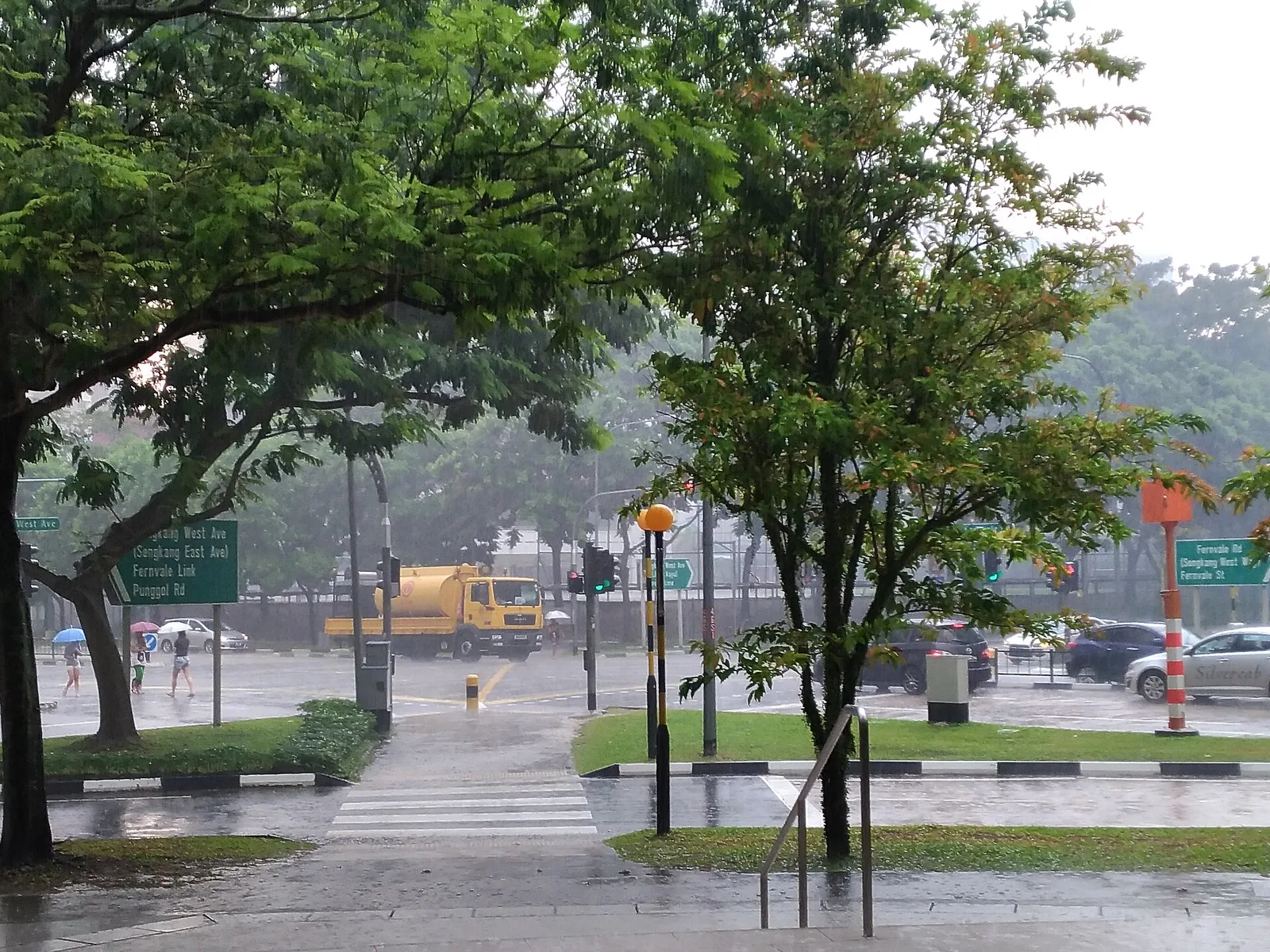

Read the temperatures for your part of Singapore
The range summarises the stations included in the most recent feed snapshot. Open the station list and choose the closest suitable location to your destination. Station air temperature varies across Singapore. A coastal station can be influenced by the sea, and weather on an exposed walk can feel different from the measurement.
Use the timestamp to check how recent the readings are. After 20 minutes, the panel labels the previous readings as last available. The temperatures come from NEA’s Air Temperature across Singapore dataset. Accessed 19 November 2026 from data.gov.sg under the Singapore Open Data Licence.
Choose the official map or forecast for your question
| Question | Open this view | Read this first |
|---|---|---|
| Where is rain showing up around Singapore? | 50 km rain radar | The newest frame and the intensity legend. Turn on the MRT or township overlay to locate your stop. |
| Is there a broader rain band beyond the local view? | 240 km rain radar | The progression over several frames. Return to 50 km to check details around your destination. |
| What might happen at my destination soon? | 2-hour town nowcast | The correct town and the printed start and end of the forecast window. |
| How much rain actually reached the ground? | Station rainfall observations | Station name, timestamp and accumulation period. The map includes rainfall over the preceding 30 minutes. |
| What is the outlook tomorrow? | 24-hour regional forecast and 4-day outlook | Match tomorrow’s date. Use the 24-hour forecast for its covered regions and times, and the outlook for a broader daily picture. |
Read a rain radar loop without mistaking it for a forecast
- Go to the newest frame. An animation can pause on an earlier image. Match its time and date to Singapore time before deciding what it shows.
- Watch the last few frames. Follow the coloured returns relative to a fixed landmark. A sequence can show movement, development or weakening. It gives no precise arrival minute and showers can form between updates.
- Check the legend and the location. The colours express radar-estimated rain intensity. A stationary patch can be a reflection from another source, as MSS notes. Use the town nowcast alongside the radar for your next decision.
For example, a radar frame labelled 2.10 pm describes a past observation. A town nowcast valid from 2 pm to 4 pm describes conditions expected within that interval. A station total labelled 2.10 pm and 30 minutes describes the preceding half hour at that instrument. Even at the same displayed clock time, the three outputs measure different things.
Worked example for a 3 pm Bayfront outing
- The evening before. Read the next day’s outlook, then check Gardens by the Bay’s attraction hours and closures. If you want a backup close to Bayfront MRT, check Floral Fantasy’s admission and availability separately.
- Before leaving at 2.30 pm. Check the closest nowcast area to Bayfront and the 50 km animation around the destination. Check both your arrival and the exposed part of the route. If the displayed forecast ends before your outdoor leg does, plan to check the next one on arrival.
- At Bayfront. If showers threaten the outdoor leg, start with a confirmed indoor plan and recheck before continuing. If a warning covers the area or the operator restricts outdoor access, choose an indoor stop and follow staff directions.
Use the same sequence when crossing the island. A dry start at your home station tells you little about a later outdoor segment across town.
Check heavy-rain warnings and lightning separately
The MSS heavy-rain warning page shows active alerts. MSS describes a typical lead time of 15–30 minutes. Check the warning area and validity when making a decision. Use the MSS Lightning Information Service to see detected lightning and the thundery-shower forecast layer. Lightning can occur away from the rain you see. For an exposed route or an outdoor attraction, follow notices from the agency and the site operator.
Sources
- NEA air temperatures by weather stationPresent air temperature readings in degrees Celsius, station names and timestamps.
- MSS 50 km rain areasLocal radar frames, intensity legend and Singapore map overlays.
- MSS 240 km rain areasWider regional radar frames and radar reflection caveat.
- MSS 2-hour town nowcastValidity window, town forecast and thunderstorm note.
- MSS station rainfall observationsRain at measuring stations, observation timestamp and accumulation window.
- MSS 24-hour forecastRegional forecast for its covered period.
- MSS 4-day outlookDay-level Singapore outlook.
- MSS heavy-rain warningWarning lead time and official alerts.
- MSS Lightning Information ServiceLightning detection and thundery-shower forecast layers.
- Gardens by the Bay opening hours and closuresVisitor information for the Bayfront example.