
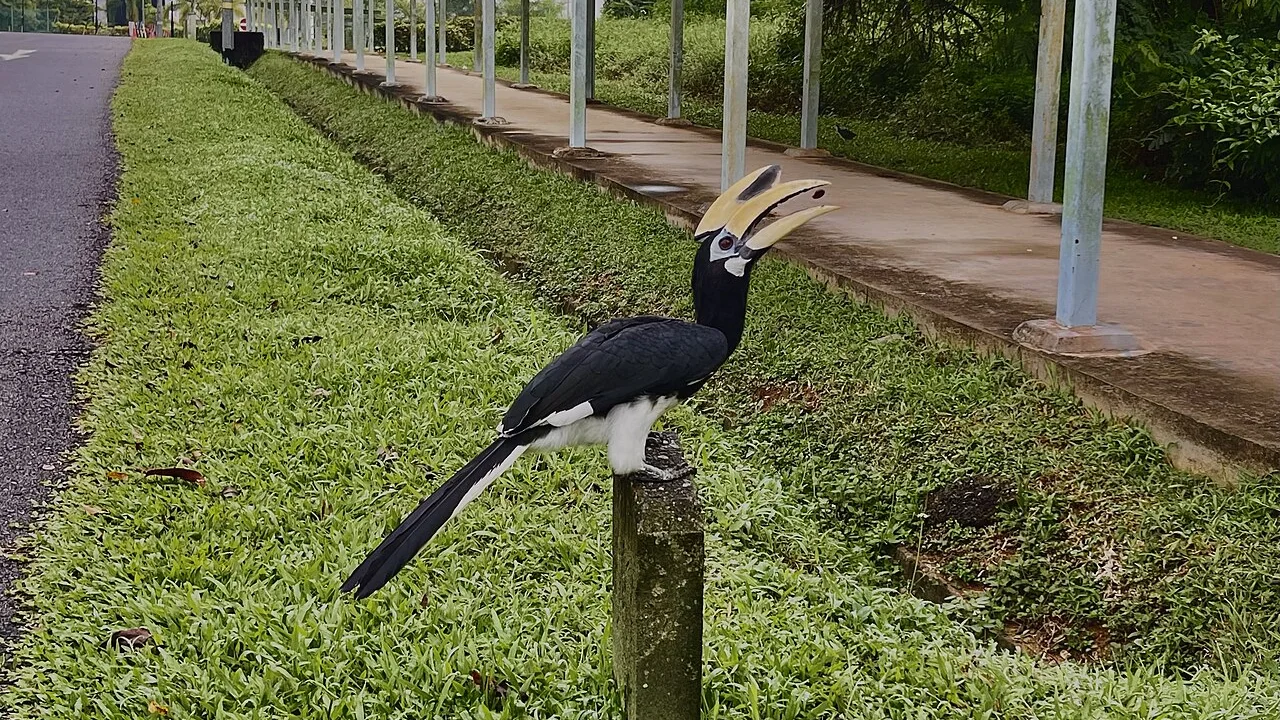
Three features to look for
- Bill: The pale, curved bill has a structure called a casque on top.
- Plumage: In flight, look for white on the underside and edges of the wings against mostly black upperparts.
- Call: NParks describes a loud, cackling call. Check what you can see as well as what you hear.
NParks notes that males generally have larger casques and red eyes, and females have a smaller casque and a black-tipped bill. Spotting these details may require binoculars.
Look for behaviour as well as markings
NParks records the species in Singapore’s parks and wooded areas. It feeds mainly on fruit and can also take small animals. Scan fruiting trees from a distance, then watch the path the bird takes as it moves. A report from one time and location cannot guarantee a sighting on your visit.
Hornbills use a tree cavity for nesting. The nesting entrance is mostly sealed, leaving a narrow opening through which the male feeds the female and chicks. If you notice a repeated visit to a tree cavity, observe from well back and give the bird a clear flight path.
Plan a low-impact birdwatching stop
Stay on the permitted path, keep noise down and avoid playing calls or putting out food to attract a bird. Use binoculars or a long lens for detail. If the bird moves away, let it go. The NParks wildlife guidance covers encounters more generally.
Where to look and how to read an urban encounter
Use NParks’ species account to choose a habitat, then take a walk that would be worthwhile without a sighting. NParks names Pulau Ubin, Sungei Buloh Wetland Reserve and urban parks. Pick the one that fits your travel time and look at higher branches or treetops from an established path. If you hear the cackling call, stop and scan before trying to move closer. Look up opening hours and access separately if visiting a reserve.
Why these birds returned: NParks links their earlier decline to loss of woodland and the large nesting cavities they need. Its conservation account explains that the species has since recovered in Singapore. Seeing one above a housing estate fits the pattern of a species using both parks and built-up areas.
If one visits your home: keep food out of reach and give it space. AVS’s hornbill guidance notes that pet birds can attract a feeding hornbill. It suggests moving cages away from its access or using cages with narrower openings. If you are keeping life lists or sharing a photo, describe the habitat and tell people where to find a public trail. Give an active nest space and avoid sharing a location precise enough to attract a crowd to the tree.
Make sense of old bird counts
An NParks publication on the bird’s return reports a 1994 record at Pulau Ubin and subsequent expansion on the mainland. Read old site counts as evidence of how the species spread. For today’s walk, choose a public place with trees, take binoculars if you have them and note what the bird was doing. A brief view in flight can still identify it if you see the pale bill and white wing edges.
Turn an ordinary walk into a short observation
Choose a public path that takes you near a mix of higher trees and open views. Stop at a place with a clear view where other visitors can pass easily. Listen before looking through binoculars. If you hear a likely call, give your eyes time to find movement along the high branches. Take a whole-bird view first. Focus on the shape of the bill and tail, then look for the pale wing edges or underside if it takes flight.
A first outing can be simple. Use NParks’ Pulau Ubin habitat information if going to the island, or choose an urban park closer to your home and make it a normal walk with a few listening stops. Use park paths and follow the site’s access notices. Plan the walk for people’s time and energy even if the bird stays out of view. Two shorter repeat visits let you compare the same route in different conditions without trying to follow a bird from tree to tree.
Record what the bird was doing and where you were standing
Write the date, general location, number of birds and an observation such as perched, flying or feeding. Keep the details you could see clearly on a separate line, and add a photo only if you took it from a suitable public position. If you could see the broad bill and white underside but missed the eye colour, say so. Young birds, distance, lighting and angle can make the smaller details hard to determine, so record individual sex only when the relevant features were visible.
For a group with children, choose one feature each person can try to spot. One person can watch the wings and another can listen for the call. Regroup while staying clear of the main path. If you see a bird making repeated flights to a tree, let it continue. Keep any public note at the park or general area level when closer information might cause other visitors to gather around a sensitive site.
What to try next after a good urban sighting
If you watched a hornbill for only a few seconds, look at the NParks species profile afterward and compare the features your eyes actually caught. Keep a short list of the park, the direction it flew and what else you observed about the habitat. If repeating the same walk, see whether there are more fruiting trees or sheltered perches in another part of the route. Choose a public vantage point and let the birds choose where they go.
People who want to learn about recovery can compare the conservation history with maps of habitats they can visit now. Ask why large nesting cavities matter and what changes when mature trees are lost. A sighting in a residential area is an observation about that place and day. Habitat and nesting information explain why preserving the conditions for future sightings matters.
Keep a short list of what you want to check
Before leaving for the park, look at one clear NParks species photo and choose two field marks you think you can see in flight. Review both once you are back so you learn which markings were visible at the distance you kept.
Sources
- NParks BiodiversitySG hornbill guideVisual identification, call, habitat and conservation context.
- NParks Flora & Fauna Web species profileScientific name, visible markings, diet and cavity nesting.
- NParks wildlife encounter advicePark wildlife etiquette.