
Work out who can approve the use of the roof
For a landed home, start with the person who controls the roof and can approve the work. Before paying a deposit, find out whether the roof is due to be repaired or waterproofed and whether there are planning constraints. A conservation area or area subject to urban design guidelines can trigger a planning permission requirement under URA’s guidance. Ask the Qualified Person to confirm the position for the address. URA solar roof planning guidelines and EMA implementation guide
For HDB residents, block solar panels are part of an estate programme. HDB describes the power serving common lifts, lights and water pumps, with excess sent to the grid. The figures in this guide illustrate a directly metered residential rooftop project. For a strata property, check the extent of private lot and common property with the managing agent and ask which approval route would apply before requesting a building-level proposal. For any rented home, start with written owner approval and the remaining tenancy. HDB programme and common services
For building management comparing a common-property proposal, start with the meter for the lifts and other shared equipment. Ask the vendor which account will receive the benefit, who owns the panels and how building maintenance and roof access will work. A quote addressed to a single household and a proposal offsetting shared loads need different consumption data.
Compare roof layouts and estimated energy output
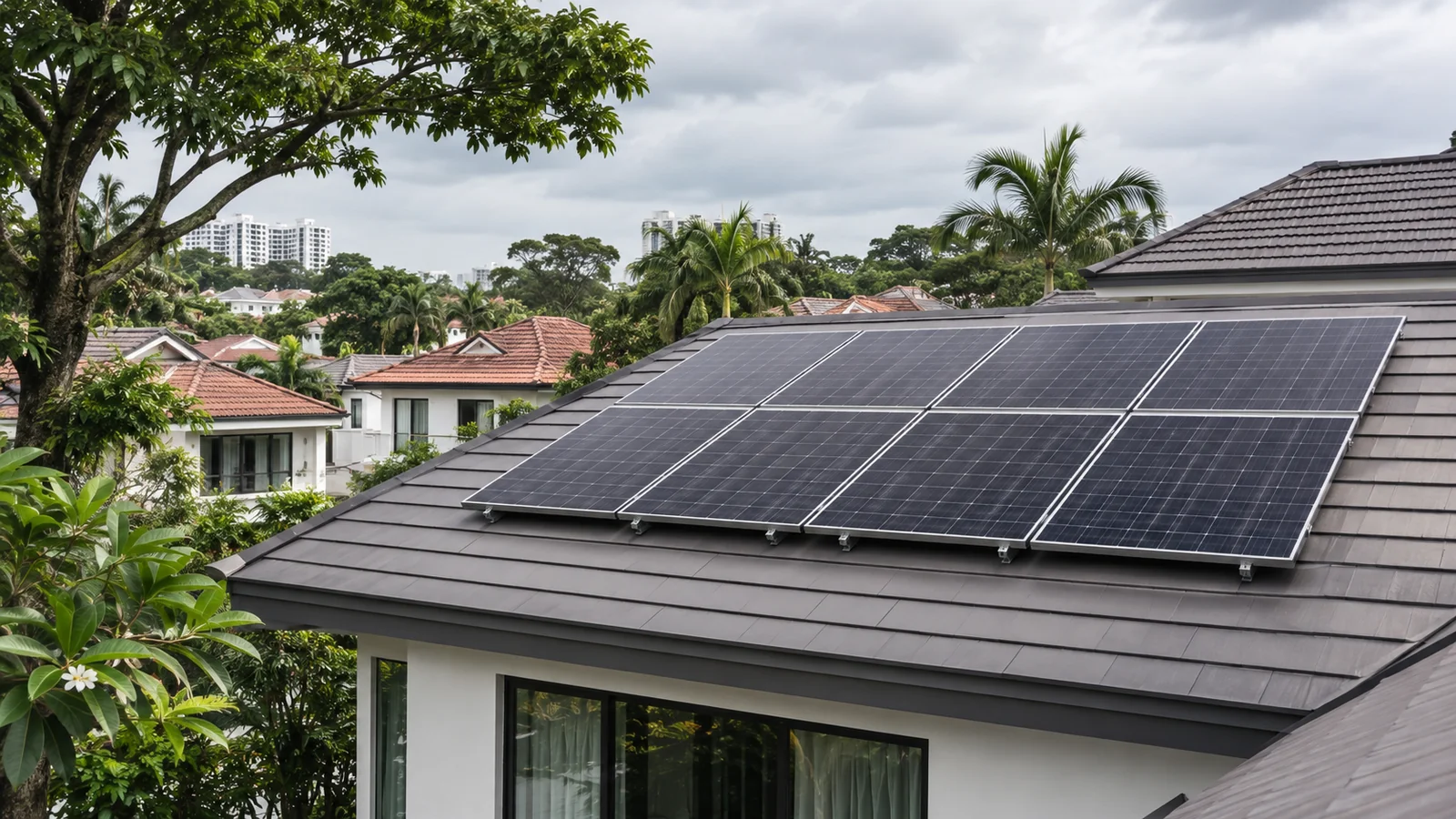
An installer should look at usable roof area, slope, the way sections face, access for maintenance and shadows from trees and buildings. A broad roof may have limited uninterrupted area once the installer accounts for skylights, roof equipment and site access. Provide drawings if you have them and ask for a layout showing each roof face. Let the qualified team assess roof structure, waterproofing and fire safety without going onto the roof yourself. EMA roof suitability, EMA system overview and Professional responsibilities
The panel array size in kWp is the sum of its modules’ rated peak output. Twenty 500 W modules, for example, make 10 kWp of nominal panel capacity. An estimate in kWh describes how much energy it may generate over a period. The inverter has its own AC rating. Check that both proposed quantities and capacities match the written quote, especially if two designs use the same marketing size with different roof layouts.
Request a monthly generation estimate as well as the first-year number. Ask how the installer estimated shading and what losses are included. A quote using 10 kWp and 11,500 kWh in year one implies 1,150 kWh per installed kWp in that example. If a second quote predicts 13,000 kWh for the same size, ask what changes in roof placement, shading model or loss assumptions account for the difference.
Use your bill and the applicable export scheme
Collect a year of bills in kWh and record who supplies your electricity. Use time-of-day readings if a smart meter makes them available. A home that runs air conditioning or other appliances in daylight can use some solar output immediately and buy fewer units from the grid. A home that uses most electricity after sunset will import more of its electricity and may export a greater share of daytime production. Compare the consumption profile with the installer’s forecast in the same time intervals where possible. EMA meters and home consumption
For qualifying households buying electricity at SP Group’s regulated tariff, EMA’s Simplified Credit Treatment pays eligible exports at the regulated tariff less grid charges. For a household buying electricity from a retailer, EMA’s Enhanced Central Intermediary Scheme can apply, with payment based on prevailing half-hourly wholesale prices. Ask the Licensed Electrical Worker to confirm the route and meter or application costs for your exact account. If you change electricity retailer, check what happens to both your imported electricity price and export credit. EMA payment schemes and SP Group residential guide
Worked cost and payback examples for landed homes
EMA publishes a 10 kWp residential example at about S$1,660 per kWp, or S$16,600 for that size, and cites typical recurring operating and maintenance costs of roughly 1–2% of residential system cost annually. The table uses S$16,600 up front and an illustrative S$249 annual maintenance allowance. The import rate is S$0.3116 per kWh, EMA’s regulated October to December 2026 rate with GST. The export credit of S$0.15 per kWh and the generation and usage shares are assumptions for the illustration. Replace them with estimates for your project. EMA cost benchmark and EMA current tariff and applicable quarter
| Assumed first-year generation and direct use | Value after assumed annual maintenance | Simple payback |
|---|---|---|
| 11,500 kWh generated. Use 40% directly, export 60%. | 4,600 kWh at S$0.3116 plus 6,900 kWh at S$0.15, less S$249. About S$2,219. | About 7.5 years. |
| 11,500 kWh generated. Use 65% directly, export 35%. | 7,475 kWh at S$0.3116 plus 4,025 kWh at S$0.15, less S$249. About S$2,684. | About 6.2 years. |
| 9,200 kWh generated. Use 40% directly, export 60%. | 3,680 kWh at S$0.3116 plus 5,520 kWh at S$0.15, less S$249. About S$1,726. | About 9.6 years. |
Simple payback divides the upfront price by modelled annual net benefit. The rates and output are held constant in these examples, with financing, component replacement and future degradation outside the calculation. Ask for a sensitivity case with lower export payments or yield. In the first row, every five cents per kWh change to the export credit changes first-year value by S$345 at the assumed export volume. Compare the downside case with how long you expect to hold the property.
Decide whether the largest roof layout is worth the extra cost
Use an incremental comparison once you have a basic layout. Imagine a larger design adds S$4,000 to the installed price and generates an extra 2,500 kWh each year. If the home would use only 500 kWh of that extra electricity directly and export the other 2,000 kWh, the incremental annual value in the earlier tariff example is about S$456 before maintenance. The extra investment has a simple payback of 8.8 years on those assumptions. If daytime consumption will rise, estimate how much of that change really falls in periods when the array has spare output.
Ask the installer how much of the difference between quotes is panels and how much is structural work, inverter capacity or work on a particular roof face. A smaller option might avoid the shade and complexity of a second roof section. Ask for both generation reports and run a conservative case for the sections with the longest shadows. If a new tree or adjoining building could shade part of the roof later, ask how the monitoring would help identify the change. EMA roof suitability factors
An adviser may also quote a cost to generate each unit over the life of the system. The National Solar Repository’s levelised cost calculator estimates that cost using assumptions including financing and lifetime generation. It does not account for the electricity bill savings. Use the output alongside the import and export cash-flow calculation. National Solar Repository calculator
Get two quotes that cover the same work
Ask both installers to itemise the panel make, model and count, inverter model, layout, scaffolding or roof access, roof works and weatherproofing responsibility, monitoring setup and commissioning. Ask for separately identified product, performance and workmanship warranties. Find out who would pay for labour, access and removal if a panel or inverter needs replacement and who holds access to the monitoring platform. At least one local installer expressly quotes by roof and configuration instead of publishing a flat rate. Example of site-specific installation quoting
Ask who appoints the Qualified Person and Licensed Electrical Worker and which approvals or submissions are included. EMA describes the Qualified Person’s role in design and regulatory checks and the Licensed Electrical Worker’s role in connection and turn-on. Put turnover documents, meter arrangements, serial numbers and a demonstration of the monitoring account on the handover list. EMA implementation process and SP Group connection guide
Before handover, ask who will investigate a drop in generation and what response time is included. Compare a maintenance package with pay-per-visit costs, including safe access, system monitoring and checking shaded areas. Keep a first-year forecast to compare with the monitoring reports. Compare equivalent times of year and give the provider both the generation data and billing records if you query the results. EMA operation and maintenance guidance
For a lease or power purchase agreement, compare the starting rate, whether it can rise, who maintains the system and what happens if you sell, refinance or reroof. Ask who receives export credits and whether there is a removal or assignment payment. If a supplier includes a battery, price the same proposal without it and ask which appliances a backup configuration would support, for how long, and what warranty applies. EMA ownership models and EMA solar components
Sources
- URA planning guidelines for solar panelsRoof planning context, conservation areas and urban design exceptions.
- EMA implementation guide for solarQualified Person, required agency checks, commissioning and Licensed Electrical Worker.
- HDB Green Innovations and rooftop solarSolarNova and power for common services in HDB estates.
- EMA rooftop solar suitability and economicsCost benchmark, maintenance estimates, roof suitability and ownership options.
- EMA preparing for solarSystem components, meters and solar installation choices.
- EMA solar export payment schemesSimplified Credit Treatment and Enhanced Central Intermediary Scheme.
- SP Group solar PV guide for residential customersResidential connection and billing arrangements.
- EMA electricity regulated tariffOctober to December 2026 tariff and tariff components.
- National Solar Repository levelised cost calculatorModel scope for generation cost and distinctions from bill savings.
- Solar+ residential installation scopeExample of a local installer’s site-dependent pricing and grid-tied configuration.