
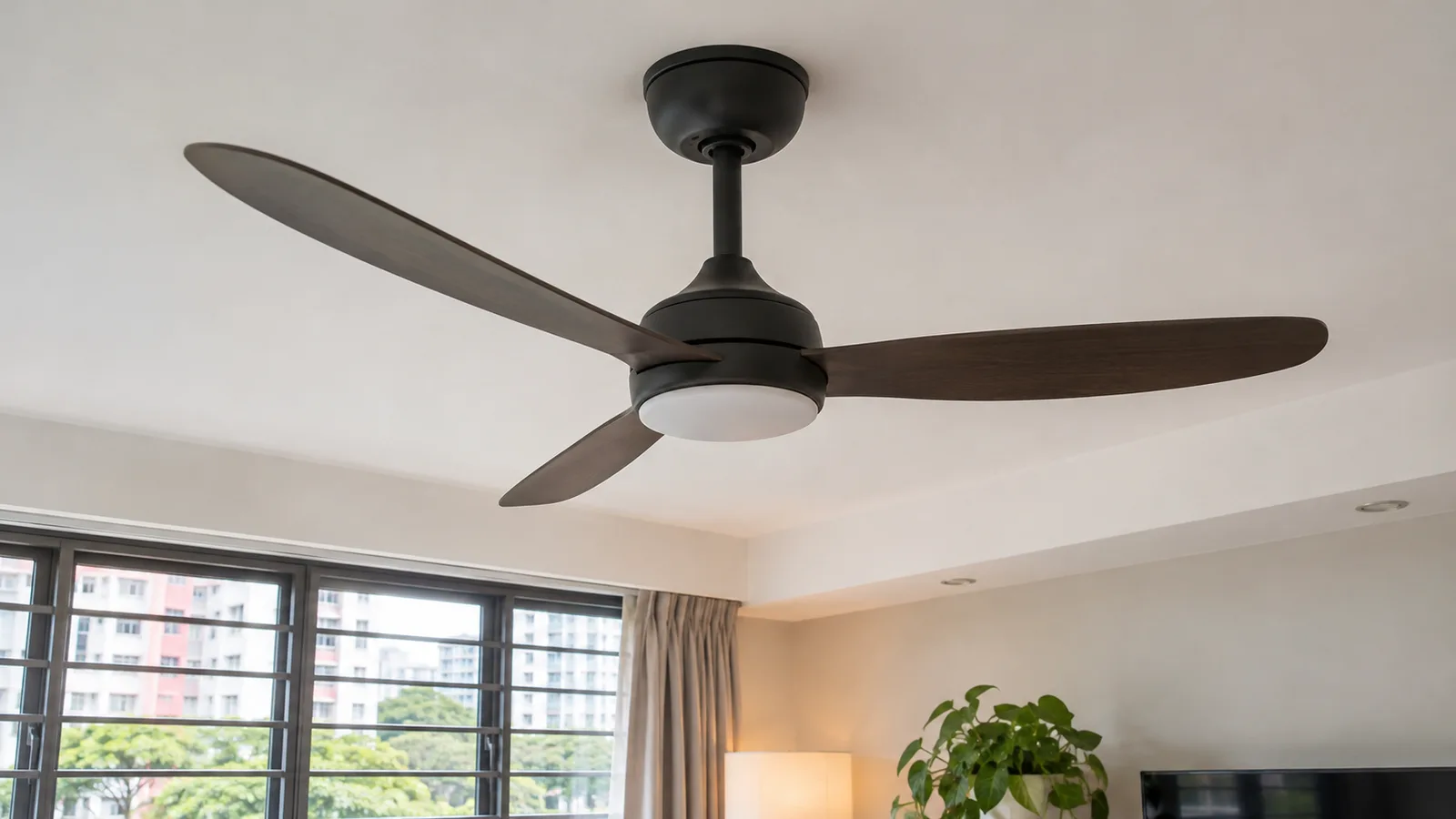
Verify the installation point before shopping by blade size
Measure from the finished floor to the mounting surface at the fan location. Take photos of the existing point, any exposed hook, false ceiling, beam, light or high cupboard. Send these to the installer with the exact model you want. Ask how far the blades will sit below the ceiling after mounting, and determine the clear height and the distance from blade tips to anything nearby. Include the planned floor finish if you are still renovating.
HDB’s electrical works guidance gives flat-specific criteria for ceiling fans, including a weight no more than 6 kg and at least 2.4 m from finished floor to blades. Ask the installer to confirm the correct mounting method and whether a particular scenario requires approval. For other property types, check building-management requirements as applicable. Use EMA’s licensed electrical worker guidance when work includes installing, repairing or altering wiring, and verify the relevant licence through EMA’s directory.
Compare the exact model and configuration before buying
| Model | Published airflow and weight | Installation decision |
|---|---|---|
| KDK U48FP | 120 cm span, 4.9 kg. Catalogue lists 6,427 CFM at high speed. Brand product listing showed S$488. | Check floor-to-blade height and whether the quoted purchase includes the installation conditions you need. |
| KDK U60FW | 150 cm span and 8,176 CFM at high speed in the catalogue. Short-pipe and long-pipe configurations are listed at 6.0 kg and 6.2 kg respectively. | Confirm the exact supplied configuration. The long-pipe figure exceeds the 6 kg value in HDB’s residential flat guidance. |
| PRISM+ Oasis 46 and 52 | Published net weights of 6.05 kg and 6.20 kg. Listed airflows of 6,160 CFM and 6,870 CFM. | Both listed net weights are above HDB’s 6 kg criterion. Resolve eligibility with the installer and authority before paying for a flat. |
Prices and available configurations can change. The manufacturer listings give you a way to rule out choices and compare what remains. Check the installed configuration and measured clearances as well as the weights. For airflow, compare how each manufacturer reports the value and which speed it represents.
Use blade span and airflow as separate comparisons
A span tells you how far the blades sweep. CFM is the manufacturer’s reported airflow in cubic feet per minute. For a small bedroom or a room with low beams, the span and blade clearance can eliminate an otherwise strong performing model. Place the intended centre on a room plan and mark the sweep radius. Consider the clothes cabinet with doors open, pendants, curtains and other nearby points. Ask the installer for the manufacturer’s minimum clearance.
For a hypothetical room with 2.65 m height at the intended site, a verified blade drop of 0.23 m would give 2.42 m floor clearance before any other change. A 0.28 m drop would give 2.37 m and fall below HDB’s 2.4 m flat criterion. Use the actual blade position after mounting when checking this. A total height to the lamp or the motor and the height to the blade plane can be different dimensions. Have the installer use the model drawing and check the finished height as part of site approval.
Compare noise by speed and conditions
Think about which speed you will normally use. A fan in a bedroom may be set low at night and a living-room fan may need higher air movement when several people are seated farther away. Use published dBA only if the manufacturer states at which speed and conditions it was measured and you have a comparable second figure. A quiet description alone is weak evidence. The air delivery from the highest setting cannot tell you how the low setting feels.
If you can see a display unit, ask to hear the model at the speed you expect to use. Listen for motor and airflow sounds while keeping in mind that a showroom has a different room, mount and amount of background noise. During handover, ask the installer to demonstrate the speeds and listen for unexpected noise or wobble on the actual mount. If movement or noise persists, turn the fan off and contact the installer before using it again.
Ask for the complete installed price
Show the installer whether there is a suitable existing electrical point and an appropriate mounting surface. Ask for separate price lines for the fan, delivery, standard installation, removal or disposal of what is there, additional wiring or switches and any site-specific support or work. KDK’s U48FP page lists examples for specific installation scenarios. Treat them as provider estimates, then confirm the actual quote for your property and model. Ask which items are payable to the retailer and which are payable on site.
For a hypothetical example, a S$488 fan with S$65 standard installation and S$40 for agreed removal would cost S$593 before any applicable tax or additional site work. A S$550 package may be cheaper if it includes those same services, or could require a separate payment after survey. Confirm the price and whether you can cancel or select another model if the installation site is unsuitable. Ask the installer which checks must occur before the item is opened if a return might be necessary.
Decide whether you want a light, remote or app control
Check the motor controls separately from lighting. A fan with an integrated light may have its own settings, replacement parts and warranty. Ask how the light can be used while the fan is off and vice versa. Review the model’s reset and remote instructions and check where a spare can be ordered. If considering an app, ask which features need a connection and what controls are available to someone without an account or phone.
For separate ceiling lights, mark their positions around the planned blade sweep. Compare at normal brightness whether the fan would pass between the light source and frequently used seating. If adding a new point or moving a fitting, request the required wiring and checks from a licensed electrical worker. For an occupied room, agree when furniture needs to move and what access the installer needs. Avoid using a different installation configuration solely to match a product’s appearance without having its eligibility and clearance checked.
Keep the installation and warranty record
Arrange a demonstration of the remote, motor speeds and any light functions. Save the receipt, product and serial number, installed configuration and contractor’s identity. Ask what the fan warranty covers and which party takes an installation or mounting issue. Check how a claim is raised, whether a call-out is chargeable and whether the warranty covers remote or electronic components. Keep the manufacturer’s maintenance instructions with this record.
When replacing a fan, have the installer check the current support and wiring for the new model. If the flat is still being renovated, confirm the finished floor and ceiling measurements afterwards. Keep the old installation description and the new quotation available while the work is underway so changes can be agreed with the appropriate trade. For a fan already in use, follow the manufacturer’s inspection and cleaning instructions and arrange professional attention if there is any unusual movement or damage.
Give the installer a brief with the dimensions that affect the quote
Send the room type and dimensions, finished floor-to-ceiling height, photos of nearby fittings, the proposed model and whether there is an existing fan or empty point. Ask for documented model suitability, actual floor clearance and what the installation includes. If supplying your own fan, state who will deal with the seller if parts are missing. Confirm the contractor who will return if an issue is identified at handover. Use the final model code and work scope to check that the purchasing invoice matches the mounting and electrical arrangements.
Compare the cost of the speed you will use
The KDK catalogue gives separate fan-only and fan-plus-light figures for several models. Its high-speed fan-only specifications show 27 W for the U48FP and 39 W for the U60FW. For an illustrative six hours per day for 30 days at those figures, the fans use 4.86 kWh and 7.02 kWh respectively. Multiply the result by your actual electricity price per kWh to estimate the cost for that usage. The 2.16 kWh difference applies only to the assumptions. Different speeds, light settings and daily runtime change the comparison.
For a fan that will run while you sleep, ask which lower speeds are available and how the controls work after a power interruption. Check the electricity figure for the setting if published. If you mainly cool a single seat while working, consider where the air will move in the room and whether a smaller or portable option serves that area with fewer modifications. For a living room that needs broad coverage, plan around the usual seating group.
Set an installation fallback for a narrow room or low ceiling
When the installer identifies a height or support problem, ask which site constraint fails and what models or other cooling options are compatible. Get the model-dependent measurement in writing. If you plan to change another fitting or use a different mounting point, have the licensed electrical worker assess the proposed work and quote it separately. When the product cannot be used at the intended site, check the return terms before unboxing or arranging another contractor.
Separate the fan purchase from the ceiling preparation
Before paying, confirm who will prepare the ceiling point and who will mount and connect the fan. A renovation contractor may be responsible for providing the agreed point, while a fan supplier may quote installation based on a point that is already suitable. Give both teams the manufacturer’s installation information and get the order of work confirmed. Ask the installer to inspect an uncertain ceiling point before final finishes or furniture make access awkward. Keep the photo and the written quote with the fan receipt, along with the person to contact if a bracket, receiver or light module needs attention.
Sources
- HDB electrical works guidelinesResidential weight, floor clearance and installation rules.
- EMA licensed electrical workersLicensed work and verification route.
- KDK U48FP listingLocal product listing and installation examples.
- KDK U60FW listingManufacturer model information.
- KDK ceiling fan catalogueAir delivery, weights and dimension diagrams by configuration.
- PRISM+ Oasis specificationsModel dimensions, net weights and stated air delivery.