
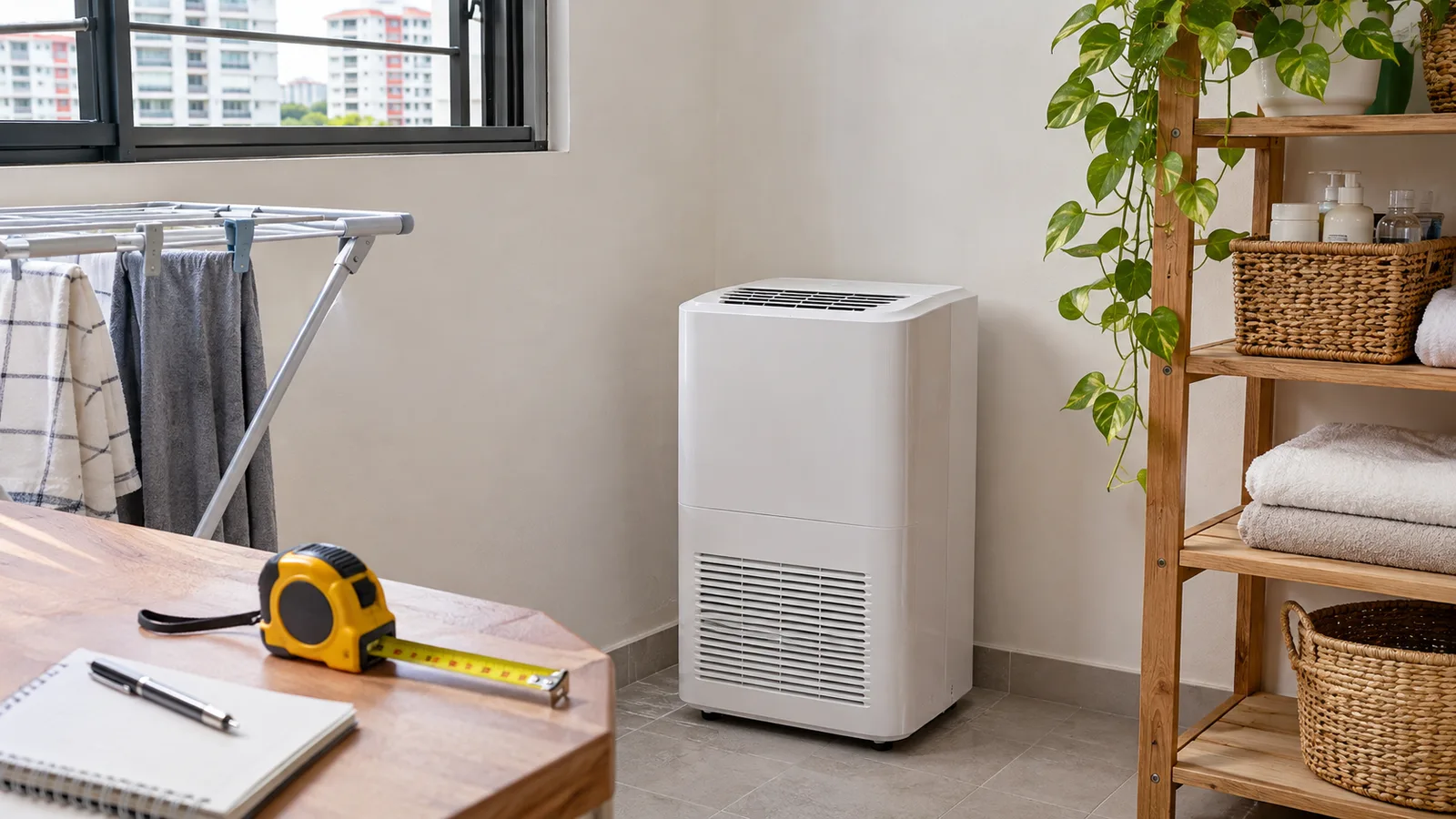
Four models compared
We used the exact models and performance figures listed on Singapore manufacturer pages. This is a specifications comparison. The figures describe manufacturer test conditions and no hands-on noise measurements are included.
| Model | Rated particle CADR | Manufacturer noise | Replacement filter to check |
|---|---|---|---|
| Philips AC1715/20 | 300 m³/h | 15 dB sleep / 50 dB turbo | FY1700/30 |
| Xiaomi 4 Lite AC-M17-SC | 360 m³/h | ≤61 dB(A) | 4 Lite Filter |
| Xiaomi 4 AC-M16-SC | 400 m³/h | ≤64 dB(A) | 4 Filter |
| Xiaomi 4 Pro AC-M15-SC | 500 m³/h | ≤65 dB(A) | 4 Pro Filter |
The Xiaomi specs list a noise ceiling. Philips lists distinct modes. These figures give you questions to ask about the speed you would use at night, and don’t establish a single cross-brand noise ranking.
The shortlist by room and use
- Bedroom and known night-mode spec: Start with the Philips AC1715/20. The sleep and turbo figures are separate, but Philips does not specify sleep-mode CADR on the comparison page. If particle delivery overnight matters, ask for a mode-specific figure.
- Smaller footprint: The Xiaomi 4 Lite base is 240 × 240 mm, whereas the Philips base is 273 × 273 mm. Check the actual clearance around the intake and whether the indicator lights can be dimmed to your liking.
- Medium room: The Xiaomi 4 has 400 m³/h rated particle CADR and measures 250 × 250 × 555 mm. Compare its price with the Lite and confirm whether the extra 40 m³/h and filter availability justify the difference.
- Higher airflow: The Xiaomi 4 Pro is rated at 500 m³/h and measures 275 × 275 × 680 mm. A single unit has the most predictable sizing when the room is distinct and its boundaries are clear. Account for connecting spaces in an open plan.
Compare room coverage on a common basis
Multiply square metres by ceiling height for room volume. A 24 m² room with a 2.6 m ceiling is about 62.4 m³. At a comparison target of four equivalent changes per hour, it needs about 250 m³/h of particle clean-air delivery. At a published 300 m³/h maximum that leaves about 50 m³/h of headroom at full power, but the same unit may fall below the target at a quieter setting.
Brands may use different test methods and time assumptions for their advertised room-size figures. The underlying particle CADR is a more useful starting point, with the pollutant and test basis noted. The EPA guide to air cleaners explains CADR, placement and the distinction between particles and gases.
How to check running cost and local support
- Copy the complete model code and locate the compatible replacement filter. The 4, 4 Lite and 4 Pro have different filter listings.
- Get a current SGD quote for the exact filter and confirm stock. Multiply it by 12 divided by your expected interval in months to compare an annual filter budget. A S$60 filter replaced every nine months is about S$80 a year, as an example rather than a quoted market price.
- Ask about the local plug and warranty for the listing you’ll actually buy. A Singapore manufacturer listing does not establish the warranty offered by every reseller or importer.
- For energy estimates, multiply power in kilowatts by operating hours and your electricity tariff. A 27 W unit running at that consumption for eight hours every day uses about 79 kWh per year. Actual use depends on speed and duty cycle.
Work out which space you want to cover
Measure the room you actually use. A rectangular bedroom that is 3.3 m by 3.6 m has about 11.9 m² of floor area. At a measured ceiling height of 2.6 m, it contains about 31 m³ of air. Four equivalent changes per hour would need about 124 m³/h of particle clean air under the calculator’s simplified assumptions. Note the fan setting you would need to sustain during the night. The largest number in the table usually describes maximum output and tells you little about the amount delivered in a sleep mode unless the manufacturer publishes both.
For an open living space, measure the rooms that share the air while the unit runs. If a 22 m² living room opens directly into a 12 m² dining room of the same 2.6 m height, use the combined 34 m² as a first estimate. That is about 88.4 m³, so four equivalent changes per hour would need about 354 m³/h. The rated 360 m³/h of the 4 Lite is close to that illustrative target at full power. The 400 and 500 m³/h models offer more rated headroom. In a long or awkwardly divided room, discuss placement and airflow before assuming either end benefits equally.
Where you have two bedrooms and sleep with the doors shut, size each bedroom on its own. The useful comparison is between a machine in the room where it is needed and a separate unit for the second room. A bigger machine outside both rooms may have limited airflow through closed doors. Use the EPA’s home air cleaner guidance for how sizing and placement interact.
Match the filter and the fan to the problem
For outdoor smoke particles during haze or fine dust that stays airborne, look at particle CADR and the fan speed you can run. The filter needs air flowing through it. A filter label by itself cannot tell you how quickly the whole machine moves filtered air into the room. Put the purifier where the intake and outlet have the stated clearance from curtains, walls and furniture. If the shape or use of the room forces the unit into a corner behind a sofa, include that limitation in your choice.
Cooking can generate both particles and gases. An exhaust hood that vents outdoors and appropriate ventilation deal with pollutants nearer the source. Particle filtration addresses suspended particles. If smells are the main concern, check what the product says about gas removal and how much carbon or other adsorbent it contains. Check the planned replacement schedule for that media. The EPA guidance explains why particle CADR and gas removal are separate comparisons. For haze alerts, take local conditions and official guidance from the NEA readings and outlook.
For visible dust on shelves and floors, regular surface cleaning handles what has already settled. Position the purifier where it has access to the room air and compare it on the airborne particles it can capture. If the unit also advertises an ioniser or another add-on feature, check whether you can run the fan and filter independently and read the manufacturer’s manual about operating it.
Compare a complete first-year budget
Write down the delivered price for the exact sales listing, how many compatible filters you expect to buy during the first year, the price of each one and the electricity estimate for a realistic duty cycle. Check whether the first filter ships installed or packaged in the box. A promotional second filter may be useful if it is the correct version and you have somewhere dry to store it.
| Cost line | Example A | Example B |
|---|---|---|
| Delivered unit | S$240 | S$300 |
| One replacement filter | S$65 | S$45 |
| Power for 8 hours a day | 25 W × 2,920 hours = 73 kWh | 35 W × 2,920 hours = 102.2 kWh |
| Estimated first-year total | S$326.90 | S$375.66 |
These figures illustrate the method. Use your own retailer quote, replacement schedule, tariff and operating speed. Check whether your estimated power draw comes from nominal maximum power, a measurement or a mode-specific manufacturer figure. If you use maximum power for a rough upper estimate, label it that way. When two machines meet the airflow requirement, compare supply of the correct filter as well as the cost. If only one seller stocks it or shipping is irregular, find out the lead time before relying on that model.
Check night use before paying
List where the purifier will stand, whether its lights are visible from the bed, and which part of the room needs to stay clear for airflow. Check if the control panel permits fixed-speed operation. Automatic mode is convenient, but the unit’s own sensor measures conditions where it sits. Near a window, doorway or cooking area, it can experience a different particle level from the opposite end of the room. Ask which settings the unit retains after you turn it off.
If a shop can demonstrate the unit, listen at the speed you expect to run and at the distance from which you will hear it. A shop and a quiet bedroom have different background noise. Some published figures use a weighted scale or apply to a particular mode. Record what the spec actually covers and use the published CADR at the same documented speed if there is one. This helps you judge whether the quieter option still meets your room’s target.
Sources
- Philips AC1715/20 Singapore specificationsRated particle CADR, dimensions, power, noise modes, warranty language and filter code.
- Xiaomi 4 Lite specificationsExact unit model, size, noise and particle CADR.
- Xiaomi 4 specificationsExact unit model, size, noise and particle CADR.
- Xiaomi 4 Pro specificationsExact unit model, size, noise and particle CADR.
- US EPA home air cleanersParticle filtration, portable airflow and the role of source control and ventilation.