
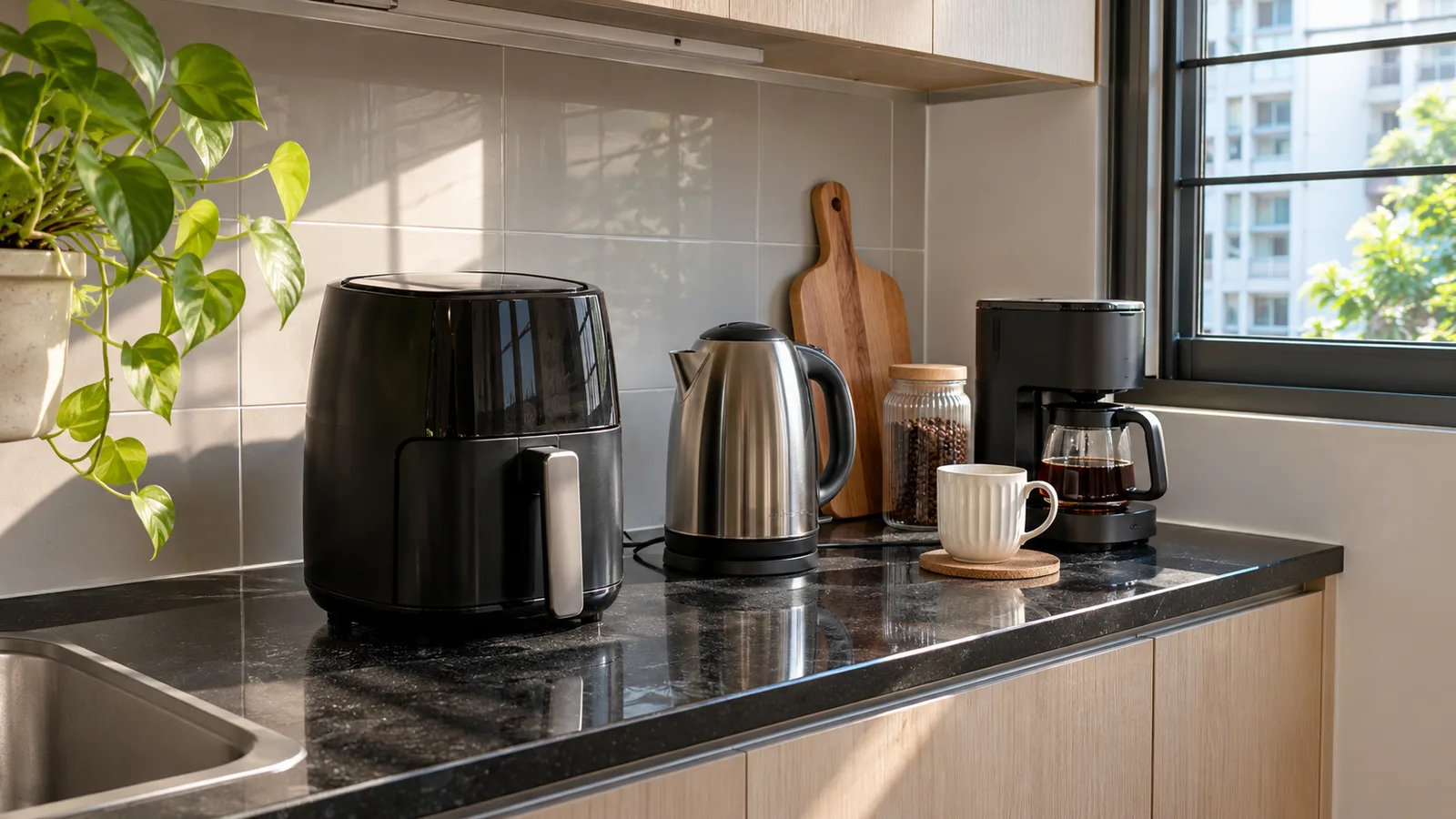
Compare three Singapore models by basket layout
| Model | Basket arrangement | When to choose it |
|---|---|---|
| Tefal Easy Fry & Grill EY5018 | One 4.2 L basket, with a grill plate. | A smaller batch or a side dish when one drawer will do. Check the base dimensions for a regular portion. |
| Philips NA231/09 | One 6.2 L basket with a viewing window. Philips lists a 1,700 W rating, 30.9 cm body width and 30.8 cm height. | One larger batch or a dish needing uninterrupted floor space. |
| Philips NA352/00 | Two drawers, 6 L and 3 L for the matching model. Philips Singapore lists 2,750 W, 38.25 cm body width and 31.42 cm height. | A main and smaller side on separate settings. Both drawers together need enough usable counter space. |
Use your own portions to choose a basket
List the three meals you would cook most often. For frozen sides or vegetables, sketch out one layer on a plate and measure the space it occupies. For long fish fillets, toast or a baking tin, measure the widest point and include handles. Ask a shop to check the basket at its narrowest point with the crisper plate installed. The rim can be wider than the cooking floor.
If the food fits in the large drawer but your side needs another temperature, the 6 L plus 3 L layout can save a separate cooking round. If both dishes need similar space, compare two same-size drawers. For cooking one wide item, check the single-basket model or an oven-style model with a tray. Tray width, shelf spacing and rotation instructions matter more than the total oven volume.
Measure the open appliance and the path to the sink
- Mark the model’s footprint on your counter, with the manual’s ventilation clearance. Leave space behind for the plug and above for any overhead cabinets.
- Pull out a mock drawer with the depth and handle position of the model. Make sure it clears the wall, counter edge and nearby appliances. Pick a nearby heat-resistant landing spot.
- Measure the largest removable part against your sink or dishwasher rack. Two smaller baskets can be easier to carry to the sink, but add a second drawer and plate to wash when both are used.
Compare energy for the number of batches you cook
At rated draw for 25 minutes, 1,700 W is about 0.71 kWh, or S$0.21 at an illustrative S$0.30/kWh. The same 25 minutes at 2,750 W is about 1.15 kWh, or S$0.34. The heater cycles, so those figures are illustrations rather than metered use. Two cooking rounds in a single basket versus simultaneous cooking in two baskets can change the result. Compare the same quantity of food and include reheating and preheating where relevant.
Price the parts you will wear out
Ask how to order the exact drawer, crisper plate or grill insert and whether it is sold separately. The NA352/00 parts listing is a starting point. Confirm actual stock and fit against the full suffix on your unit. Check the manual for dishwasher-safe parts and care instructions. Ask what the local warranty covers for the heater, controls and removable parts, and keep the model label and receipt.
Use the area of the basket to plan a complete meal
Draw the base of the basket and lay out the food you usually cook. If you make four fillets or patties that need to lie in a layer, check how many fit in the usable shape after leaving the spacing the manual requires. A nominal basket volume includes height you may use for some foods and little of for others. Compare whether an additional run would be practical on a weeknight.
For a family meal with a main dish and vegetables, draw both batches separately. A two-drawer model can hold each at its own time and temperature if those controls are supported. Check which drawer is large enough for the largest main item you cook. A single larger base may fit one large piece that would be awkward to divide between two drawers.
Check the position beside a cupboard, sink and serving area
Measure the drawer’s travel when fully out and where you can place a hot basket. Use the manufacturer’s directions for ventilation and clearance. Tell someone where the appliance will stand so they can test whether the cord and power point will work as intended. Compare where the door and a nearby cupboard would be open while you remove a batch.
At the sink, check how the insert or rack comes out. Measure the largest part against the sink and dishwasher rack if the manual says it can go there. Some coatings require a specific tool or washing approach. Compare the time to wash and dry all the pieces with what you already use, especially if you cook more than one batch and food residue needs to come off between them.
Choose the model for the food you will actually replace
Run one example with a side dish, one with the main meal and one with leftovers. Note the time for preparation, cooking and cleaning. Compare whether reusing the oven for two trays would be easier than using a smaller basket in several runs. If a feature claims to synchronise two drawers, find its exact control description and check what happens when one needs longer. Ask for the spare insert and basket code and include it in your comparison if you expect to replace either part during regular use.
For an energy estimate, add the periods each appliance would actually run. Use measured or documented power figures at the relevant settings when you can. Compare the results over several similar meals. A rating multiplied by time is a rough estimate when the heater cycles during cooking.
Check how the appliance handles a second batch
Think through how you would keep the first batch warm while the next one cooks. If all the food needs to be served together, compare that delay with using the larger tray or two drawers. Follow the manual for repeated cooking and how to handle hot inserts or accessories between batches.
Plan a one-drawer meal and a two-drawer meal
Choose a meal your household eats every week and make a short schedule for the food. For one drawer, place the largest food portion on a sketch of the basket. Check whether the second item can be prepared at its own time and temperature while the first item waits. Use the manufacturer’s cooking and handling instructions when putting different foods in the same appliance. A single large drawer can keep the largest item in one piece and can still require a separate run for vegetables or a side.
For the Philips dual-basket example, work out which item goes into the 6 L drawer and what would fit in the 3 L one. Keep the large part of the meal in the drawer with the surface it needs. Check whether the programme you want is available at the same time in each drawer and whether the controls let you coordinate the end time. Think through when one item needs to be removed to prevent overcooking. Look at the short sequence you have drawn before choosing the dual layout for every meal.
Choose accessories with the appliance’s size and programme in mind
For a grill plate or small pan, look up the manufacturer’s guidance on the size, safe materials and clearance from the heating element. Check how the accessory sits in the basket and how it can be removed while hot. If a foil or paper liner is relevant to something you cook, use only arrangements the appliance’s directions support. A liner or tray can change the air path around food, so check how the manual expects it to be fitted and used.
Price the actual pieces included in a local order. A shop demonstration might include a rack, grill plate or pan that comes with a different package. Ask for the exact accessory numbers and check that a part can still be purchased from a local seller after the warranty period. For a difference in basket price, compare how often the added part changes what you can cook.
Compare the cleanup on a meal you would repeat
Start the comparison with the appliance cold and put away. Include taking it out, arranging the food, closing the drawer, unloading the meal and cleaning the pieces. A narrow basket may take up less room at the sink. Two baskets, inserts or handles can take longer to wash if you use both frequently. If your kitchen has a dishwasher, check which parts can be cleaned in it and test whether they fit alongside the rest of the night’s dishes.
Keep the counter and serving steps visible. If somebody needs to make food while you clean, decide where the appliance and any hot pieces can sit. Ask the seller how it expects you to clean underneath the insert and the edges of the drawer. If you are comparing two returns policies, check when preparing food or opening the accessories changes the options for a return.
Compare a smaller reheating job separately
If you mainly reheat one serving at a time, try that pattern against both basket shapes. A smaller insert that fits a standard portion may be simpler to handle and clean. If you also cook for a family on weekends, repeat the comparison with the larger load and count how many times you would need to empty and refill the basket. The everyday choice and the occasional big meal belong on the same shortlist.
Sources
- Tefal Singapore Easy Fry EY5018Model, basket capacity and supplied grill plate.
- Philips Singapore NA231/09 specificationsBasket capacity, dimensions, viewing window and power rating.
- Philips Singapore NA352/00 specificationsDual basket, dimensions and power rating.
- Philips Australia NA352/00 basket splitIndividual drawer capacities for the matching model.
- Philips Singapore NA352/00 partsModel-specific accessories and support.