
Choose a format for how people will handle the sticker
Start by naming the object and where the stickers will be used. A shop packing the same product each week needs a fast peel and a supply that stays in order. An event organiser may want a sticker with its own backing so one can be handed to every guest. A bottle label has to fit the curve, while a seal for a paper bag needs to work across a fold. Send that use case with the dimensions.
| Format | Good starting point | Ask for in the quote |
|---|---|---|
| Multiple stickers on a sheet | Short batches of labels applied by hand or sold as a set. | Number on each sheet, total usable stickers, finished size and how easily each piece lifts from the backing. |
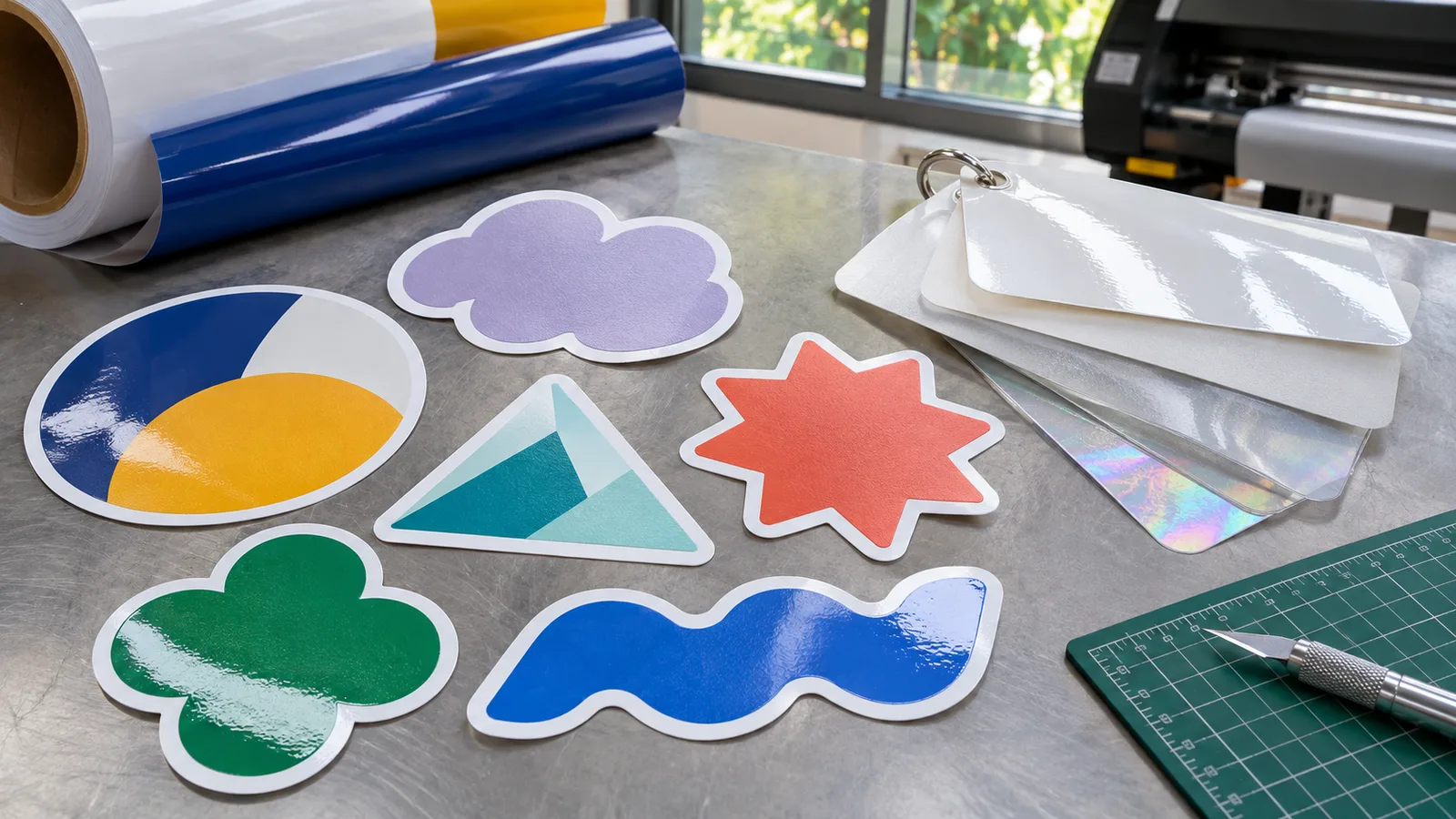
| Individual die-cut pieces | Display inserts, giveaways and designs whose outer shape matters. | Finished cut path, backing shape, corner treatment, quantity per design and how the pieces are packed. |
| Roll labels | Repeating the same label on many packs, particularly with a dispenser. | Core size, roll diameter, wind direction and whether those match the way the label will be applied. |
Gogoprint’s sticker range and its die-cut configurator show how printers separate formats. Check each product’s available size, material and order terms. Ask the printer to explain when it uses a partially cut face stock on a larger backing and when it cuts through the backing as well.
Work from the surface, moisture and removal requirements
Bring a sample of the item the label will go onto. Describe the surface, its shape and the temperature at application and during use. For a glass drink bottle, explain whether the label goes onto dry glass and whether it encounters condensation later. For a parcel, say whether the sticker needs to keep a paper fold shut or merely identify a pack. If you need to remove it cleanly, ask what removable adhesive and sample tests the printer can offer for that surface.
For a small launch, order a sample before a full print run. Apply it under the intended conditions and check whether the edges lift, how the print looks and how it responds to ordinary handling. A coating can affect resistance to water or scratching, and the adhesive solves a different part of the problem. Ask the printer to specify both the label material and the adhesive, especially for packaging that will be chilled, reused or wiped frequently.
If a label has to comply with a packaging or safety requirement, begin with those rules for the product and market. Give the printer a finished design with the required wording and size. Make sure the proof is readable on the smallest pack and that colour contrast works under typical lighting. A printer’s production check only covers the work it says it checks.
Make up a small proof before handing over the artwork
Open the printer’s requirements for the product you are ordering. Find out what it wants for finished size, trim allowance, colour format and a separate cut line on a custom shape. A printer may specify a different artwork setup for stock rectangles than for a shape whose outline goes around printed detail. Use the line name and layout its system expects.
Print the proof at the normal size on scrap paper. Wrap that around the container or place it on the laptop or bag where you intend to use the sticker. Check small letters, internal margins and the space around the main illustration. If you have a QR code or barcode, test the final intended size and surface as part of the proof check. Send any adjustment to the printer before accepting production.
For more than one design, label files with a simple design name and quantity. Ask for a proof for each variation and check that art containing photos or transparent elements has the intended background on the stock. Keep an approved copy with the order so you can confirm which design and size was released if you reorder later.
Compare usable stickers and the date they will be in your hands
Get prices for the same design count, material, finish and size. Compare cost per usable sticker, including any materials, proof, delivery and tax charged on the actual order. For illustration, suppose 200 pieces cost S$48 with S$8 delivery. That is S$56, or S$0.28 per piece before any other applicable charge. If only 150 will be used and the rest are unlikely to be needed, the amount spent per used sticker would be about S$0.37. Substitute your actual quotes.
When ordering for a fixed event, put artwork approval, production, dispatch and delivery on four different dates. Ask what happens when approval misses the printer’s cutoff or the printer requests a revised file. If collection is possible, confirm which location and opening hours apply to your job. For an order going to multiple offices, compare one pickup with several individual deliveries.
Get any rush price and turnaround conditions in writing. Ask what date means the job is complete and when the provider expects it to reach your address. For a trial run, confirm whether the result uses the same material and finish as a later larger run. Compare the total again if you decide to change the cut shape or divide one order across several designs.
Retain a baseline for the next print run
When the first batch arrives, keep an unused sheet or a few pieces in the project file. Record the stock, adhesive, finish and supplier’s job reference. Check a sample from different packs or rolls against the approval. Look at the size, colours, edges, placement of the cut and whether the backing releases as expected. Ask the provider how it handles a print defect before distributing the order.
For an order a few months later, send the previous job reference and state which details will change. If the products or packaging have changed shape, compare the old sample with the new surface before ordering the full quantity. A repeat quote should specify whether the same material is still available and whether the new minimum or production time differs.
Sources
- Gogoprint Singapore stickers and labelsProduct routes and selectable sticker format details.
- Gogoprint Singapore die-cut stickersCustom-cut product and configuration requirements.