
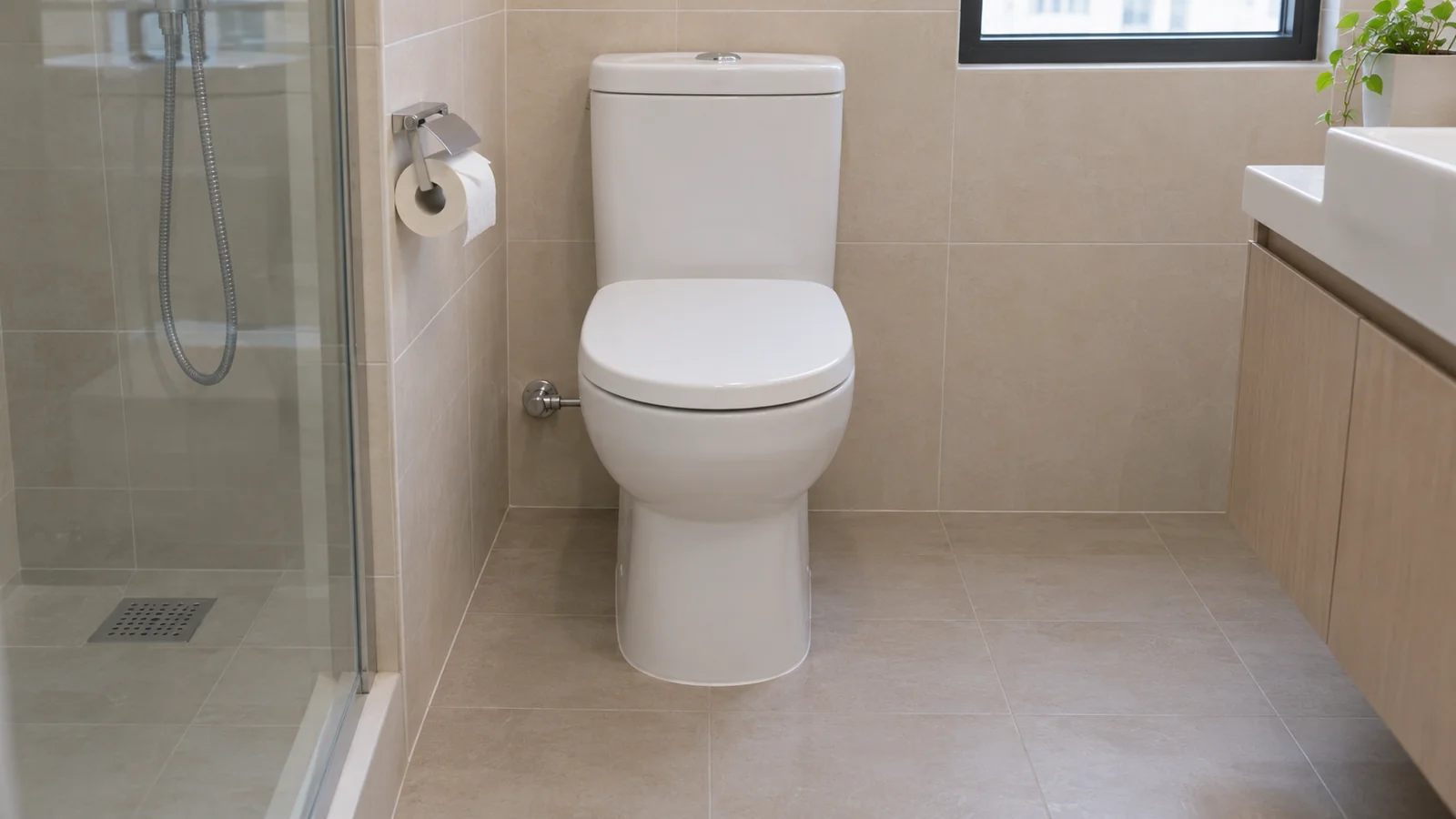
Find out which outlet your bathroom has
An S-trap connects to a floor outlet. Its rough-in is typically the horizontal distance from the finished rear wall to the centre of that outlet. A P-trap generally connects to a wall outlet, and its drawing may specify the outlet centre height above the finished floor. Use the manufacturer’s dimension drawing for the exact reference points. The existing pan can hide the connection, so a picture of its shape alone can leave the fit unresolved. Saniton example showing floor and wall outlet variants and American Standard floor-outlet drawing
Send the plumber photos of the bathroom from the doorway, the sides of the current toilet and the pipework you can see. Include the position of the tap, vanity and any boxed-in services. Have them identify the outlet and rough-in on site if it is unclear. Ask which connector the proposed model requires and how far the front of the bowl will sit from the real wall once fitted. Keep the existing bowl in place until the replacement has been confirmed.
The difference between 140 mm, 150 mm, 250 mm and 305 mm matters even where the models look alike. For example, a confirmed 140 mm S-trap gives you a reason to price the listed 140 mm Camellia variant first. If a quote allows a different model using a connector, ask for the proposed part and the installed dimensions in writing. Camellia rough-in options and Example 305 mm S-trap drawing
Singapore toilet bowl models by fit
These are examples from Singapore manufacturer listings checked on 19 November 2026. Dimensions are listed as depth × width × height in millimetres. The product height on these sheets describes the fixture. Measure floor to seat separately when comparing comfort.
| Model | Published dimensions and outlet | Check before buying |
|---|---|---|
| Saniton Camellia ST2488/SC3033 | 665 × 383 × 748. The range lists 140 or 250 mm S-trap and a 185 mm P-trap option. | The listed three-tick S-trap variants end in SC3033-3 and use 3.5 L full and 2.5 L reduced. Confirm the exact label if offered a different variant. Model specifications |
| American Standard Loven CCAS1862-1320411S0 | 720 × 370 × 705. S-trap at 150 or 250 mm as specified. | The technical sheet lists 4 L full and 3 L reduced, with the seat excluded for this SKU. Ask what the retailer bundle includes. Technical sheet |
| American Standard Acacia Supasleek one-piece CL20075-6DASGCBT | 747 × 385 × 634. 305 mm S-trap. | The sheet lists 4 L full and 2.6 L reduced. Check whether the additional projection suits the room. Technical sheet |
| American Standard Acacia Supasleek wall-hung CL31197-6DACTPTN1 | 555 × 376 × 360 exposed pan. P-trap. | Get the matching cistern, frame, flush plate and finished wall drawings with the quote. Model specifications |
| Saniton Delphinium wall-hung | 560 × 335 × 395 exposed pan. Concealed system. | The manufacturer lists both two- and three-tick compatible R&T cisterns. Get the code and label for the combination quoted. Model specifications |
A close-coupled model has a separate tank sitting behind the bowl. A one-piece model integrates the tank and bowl, reducing the number of exterior seams. A wall-hung pan leaves the floor below it clear and a concealed system adds parts behind the finished wall. Ask how the plumber will reach its serviceable fittings after tiles are in place.
Measure the room as people use it
Start with the rear finished wall and mark the predicted front of the installed bowl on the floor using removable tape. Open the door and shower screen fully. Stand in the normal approach and check for room at your knees and feet. Look for a vanity drawer, towel hook or bidet hose that could get in the way. Draw the bowl’s widest point as well if the toilet sits close to a vanity.
For example, if you measure 1,160 mm from rear wall to a fixed obstruction and the plumber confirms an installed projection of 720 mm, the remaining measured space is 440 mm. A 747 mm projection would leave 413 mm. If a concealed wall projects 110 mm into the room and the chosen pan extends 555 mm beyond it, the total projection from the original wall is 665 mm in that example. Use the finished drawing and real door swing for the decision. These numbers show the arithmetic. Allow clearance appropriate to the household and layout.
If a family member needs a particular sitting height, record a height they find comfortable and ask for finished-floor-to-top-of-seat dimensions. In the showroom, confirm whether the display has the same seat and model number as your quote. Tell the plumber if the opening, lift or stairs looks tight for delivery, especially for a one-piece fixture.
Read the WELS label for the complete flushing setup
Look for the mandatory WELS label and its registration number on the exact combination being sold. For a concealed cistern, record the pan and cistern codes and ask the supplier to confirm the compatible combination. Go through the official PUB WELS overview and registered product search when a title, picture or brochure omits the suffix. A product family can be sold with different flush volumes, as the Saniton Delphinium listing illustrates. Saniton’s cistern options
PUB’s published requirements set the three-tick limits for dual-flush cisterns at 3.5 L per full flush and 2.5 L per reduced flush. The two-tick ranges are over 3.5 through 4 L for the full flush and over 2.5 through 3 L for the reduced flush. The installation must use a compliant setup. The WELS label gives you efficiency data to compare alongside fit and parts availability. PUB flush thresholds
For a home averaging four full and eight reduced flushes a day, a 4 L and 3 L setup uses 40 L daily. A 3.5 L and 2.5 L setup uses 34 L on the same pattern, a difference of 2,190 L or 2.19 cubic metres per year. Substitute your own estimated flush counts to gauge the scale. If water is continuously running into the bowl, have the cause assessed before deciding whether the flushing parts or the complete toilet need replacement.
Decide whether you need a new bowl or a repair
A toilet that refills by itself or leaves a trickle into the pan may have a cistern leak. PUB describes looking for water streaks or ripples in a bowl that has been sitting unused and recommends a licensed plumber to detect and repair confirmed leaks. Photograph the model information you can reach and record when the problem appears. It helps the plumber quote a compatible part, particularly if the original manufacturer sells several flushing mechanisms. PUB cistern leak guidance
If the fixture is sound and parts are available, ask for the price to repair the affected component and its warranty. Ask for a separate replacement quote if a professional identifies a damaged pan, a leak at the discharge connection or parts that cannot be sourced. For recurrent problems, ask the plumber to explain the cause and the proposed work before spending on a new model. A different bowl can still connect to the same underlying pipework.
Ask for a quote with the work itemised
Start with two quotes that separate the toilet bundle, the seat and fittings, delivery, labour, old-pan removal and disposal. Check for named connector or cistern parts, additional travel or stair charges, GST and any included testing. Ask who is responsible for damage or making good if the new bowl exposes the footprint of the previous one. If a different connector or repair is found to be necessary, ask how changes will be priced and approved.
Check the product and installation warranties separately. Ask whether the seat, hinge, flush button and internal mechanism are covered, who handles call-outs and whether the supplier stocks replacement parts. A concealed tank should have a defined service access route. If ordering the toilet before an installer arrives, confirm the return terms for unopened stock and when the retailer considers it used.
For a single-toilet household, book delivery and plumbing together or have the replacement onsite first. Verify the box label and visible condition before removal starts. Agree when the toilet can be used and ask the installer to demonstrate both flushes and check around the connections during handover. Retain photos of the technical label and the itemised invoice.
Who should carry out the work in Singapore?
Arrange regulated plumbing work through a PUB Licensed Plumber. For an HDB flat, read the specific toilet-pan conditions and have the plumber confirm what can be done at the existing location. Changes involving a wall-hung installation, layout or discharge route should be checked against the applicable rules before you buy equipment or schedule the work. Use PUB’s plumber lookup to check the name of the person handling the regulated work. PUB plumbing work guidance and HDB toilet-pan conditions
For an electric bidet seat, confirm bowl shape, hinge spacing, physical clearance and the manufacturer’s power and water requirements. If the job needs new electrical work, ask an EMA Licensed Electrical Worker to assess it. For a rental, get the owner’s approval for the fixture and proposed work. EMA licensed electrical worker guidance
Sources
- Saniton Camellia ST2488/SC3033Dimensions, trap variants, three-tick model identifiers and flush volumes.
- American Standard Loven CCAS1862-1320411S0Product dimensions, S-trap options, flush volumes and seat exclusion for this SKU.
- American Standard Acacia CL20075-6DASGCBTExact one-piece model dimensions, 305 mm S-trap and rated flush volumes.
- American Standard Acacia CL31197-6DACTPTN1Wall-hung pan dimensions, P-trap and product documents.
- Saniton Delphinium wall-hung panExposed pan dimensions and compatible concealed cistern options.
- PUB Water Efficiency Labelling SchemeLabel, registration number and link to the official product register.
- PUB water-efficiency thresholdsFull and reduced flush amounts for two- and three-tick dual-flush cisterns.
- PUB guidance on spotting a cistern leakVisible leak signs, leak detection support and repair guidance.
- PUB licensed plumber searchOfficial lookup for checking the person who will carry out regulated work.
- PUB plumbing work requirementsRegulated work and examples of simple plumbing works.
- HDB sanitary plumbing and toilet-pan renovation guidelinesHDB technical conditions for replacing a toilet pan and making changes to the sanitary layout.
- EMA guidance on licensed electrical workersWho to engage when electrical work is needed.